Buying Guide
How Dental Hygienists Should Choose Loupes and a Headlight — and How It Differs From a Dentist's Setup
2026-10-06 · Jizhou Select
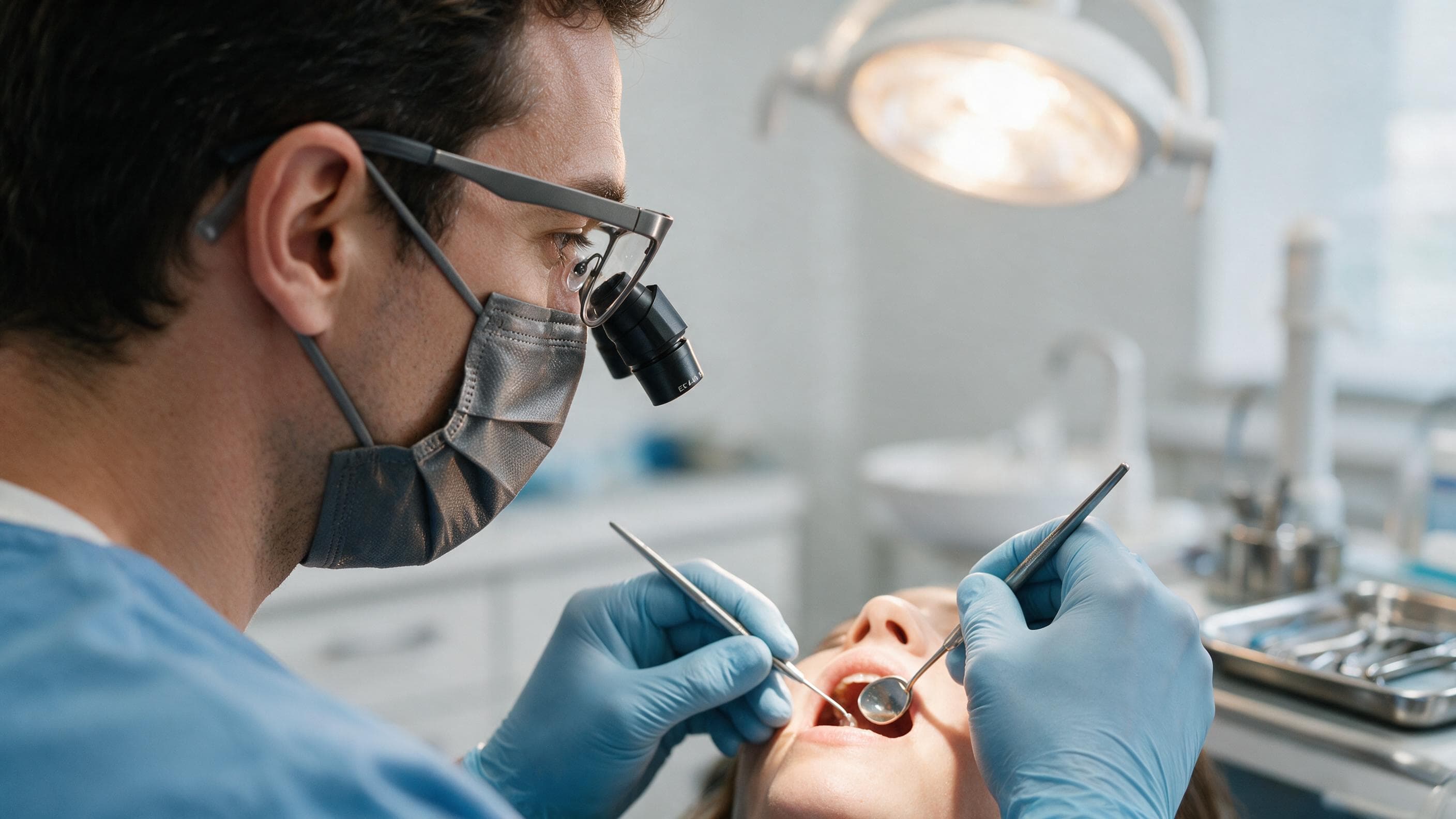
Bottom line first: a hygienist's loupe setup doesn't follow the same logic as a dentist's. If your day is mostly scaling, basic periodontal therapy and routine exams, there's no need to push magnification higher — 2.5X or 3.5X is usually enough. What genuinely deserves the effort is getting your working distance and pupillary distance right, and factoring the light into the decision from the start.
A background note worth having: among dental professionals, the 12-month overall prevalence of musculoskeletal disorders was 82.4%, with the neck highest at 75.2% (Zhang et al., 2021, n=614). Those numbers come from a dentist population, but hygienists spend just as many hours at the chair, so the setup deserves the same serious treatment.
1. Choosing Magnification: Don't Copy a Dentist's Setup
Our magnification lineup designates 2.5X for general examination and scaling, and 3.5X for advanced general work, routine restorative procedures and basic periodontal therapy — precisely the range a hygienist lives in. Dentists move up to 4X and above because endodontics, precision restorative work and periodontal surgery demand finer detail; but at those magnifications the field of view is only 50-95mm, which is more hindrance than help when you're scaling.
Magnification, field of view and depth of field trade off against one another. Choosing a magnification is really choosing which kind of "seeing" you need most. Scaling calls for seeing the whole area and seeing it steadily: 2.5X gives 150-170mm of field, and 3.5X still gives 110-130mm.
2. Choosing the Optics: Straight or Angled
Straight optics bring light into the eye in a straight line — the barrel points where you look, so there is virtually zero adaptation and you can be in the clinic the same day. The trade-off is that your line of sight still angles downward; a custom long working distance is what turns "leaning in close" into "a slight forward tilt". Angled optics use a prism to deflect light from the treatment area below by roughly 40-45°, letting you look straight ahead with the head and neck close to neutral — but expect about a 1-2 week adaptation period to rebuild your spatial sense.
Our position is clear: this is not a low-end versus high-end question. For a first pair, and for hygiene-dominant work, starting with straight optics is the steadier choice. If you already have loupe experience and are carrying a noticeable neck and shoulder load, then consider angled optics.
3. Choosing a Headlight: Enough Power, No Compromise on Light Quality
Our lighting guidance: for routine exams, scaling and fillings, 20,000-40,000 LUX is already comfortable; only deep posterior cavities, endodontics, or magnifications of 4X and above call for 40,000 LUX or more. For shade matching, look at color rendering — nothing below CRI 90+ is worth discussing — and keep color temperature in the 5000-6000K neutral white range.
The AcuBeam headlight delivers 40,000 LUX, CRI 90+, 5800K, and 28g for the complete unit, with a 1-hour fast charge and 2 hours of runtime per battery; the kit includes 3 batteries for rotation. The dental chair light comes in from above and behind your head, so head, shoulders and hands all sit in its path, and the interproximal surfaces of posterior teeth are blocked most heavily — that is the problem a headlight solves. If you choose angled optics or higher magnification, less light reaches your eye, and our guidance is to pair it with a headlight.
4. Custom Parameters: Get One Wrong and the Benefit Drops to Zero
Our position: get pupillary distance, working distance or prescription wrong — any single one — and the ergonomic benefit goes to zero, or even negative.
Asian adults' PD typically falls between 54-72mm, and near PD runs about 2-4mm smaller than distance PD, so re-measure with a pupillometer. Measure working distance yourself: sit in your standard posture, have a colleague lie back in the chair to simulate a patient, keep your torso upright with both hands at the treatment area, then measure the straight-line distance from the corner of your eye to the treatment area — three measurements, averaged. Report exactly what you measure, and err long rather than short. Common built-in steps are 340/420/460/500mm and above; land on the step closest to your measurement. Prescriptions for myopia, astigmatism and hyperopia can all be built into the lenses.
5. Try-On: Take It Into the Clinic Before You Decide
We don't publish prices on the website; submit a try-on request and a consultant quotes you 1-on-1 based on your configuration. Four steps: tell us your needs and your clinical scenario, confirm the plan and pay a deposit (loupes ¥3,000, headlight ¥1,000), try it out during the 5-day try-on window after it arrives, then pay the balance if you're satisfied or ship it back if you're not. The 5 free try-on days start the day after delivery, and you can request a 2-3 day extension. If it isn't right, ship it back and the full deposit is refunded within 48 hours of receipt.
FAQ
Q1 What's the biggest difference between a hygienist's setup and a dentist's? Magnification and the choice of optics. A dentist doing endodontics and precision restorative work moves to 4X and above and to angled optics; a hygienist whose day is scaling and basic periodontal therapy is covered by 2.5X-3.5X straight optics in most situations, and should put the emphasis on working distance and the headlight instead.
Q2 For a first pair of loupes, 2.5X or 3.5X? Our guidance is that a first pair doesn't need to be perfect in one step — it needs to be usable. Start with the lower magnification: larger field, easier to adapt to. Choose 2.5X if scaling dominates; if basic periodontal therapy makes up a large share of your work and you want finer detail, then consider 3.5X.
Q3 If I'm only buying one thing, loupes or headlight first? It depends on where the problem is. If it's "I can't see the details clearly", get the loupes; if it's "my own body blocks the light and I can never see the interproximal surfaces of posterior teeth", the headlight comes first.
Q4 Does the try-on cost anything? Pay a deposit (loupes ¥3,000, headlight ¥1,000); if you're not satisfied, ship it back within 5 days and the full deposit is refunded within 48 hours of our receiving the product. If it isn't shipped back after the deadline, an occupancy fee of ¥50 per day applies, capped at ¥300.