Why Generic Loupes Can Hurt Your Neck More
The ergonomic benefit of loupes comes from one simple idea: fix the sharp image zone directly in front of your eyes when you sit upright, and you no longer bend or hunch to reach it. When the parameters are wrong, that logic inverts — your body starts reaching for the loupes instead.
Wrong PD: the two visual axes cannot pass through the optical centers of both barrels at once, and the brain is forced to keep fusing two misaligned images — felt as dizziness, double vision, and a tight brow. Many people conclude they are "just not loupe people" when the PD was simply wrong; some unconsciously tilt the head to use one eye, loading the neck muscles on one side for years.
Wrong working distance: the sharp zone is not where you sit upright — too short and you bend forward to reach it, too long and you lean back. Generic loupes are designed for the "average person," but there is no average person in the clinic. In a survey of 614 dentists, the 12-month prevalence of musculoskeletal disorders was 82.4%, with the neck leading at 75.2% — prolonged static postures and uncomfortable working postures are established risk factors. A loupe with wrong parameters is precisely a tool that nails you into the wrong posture.
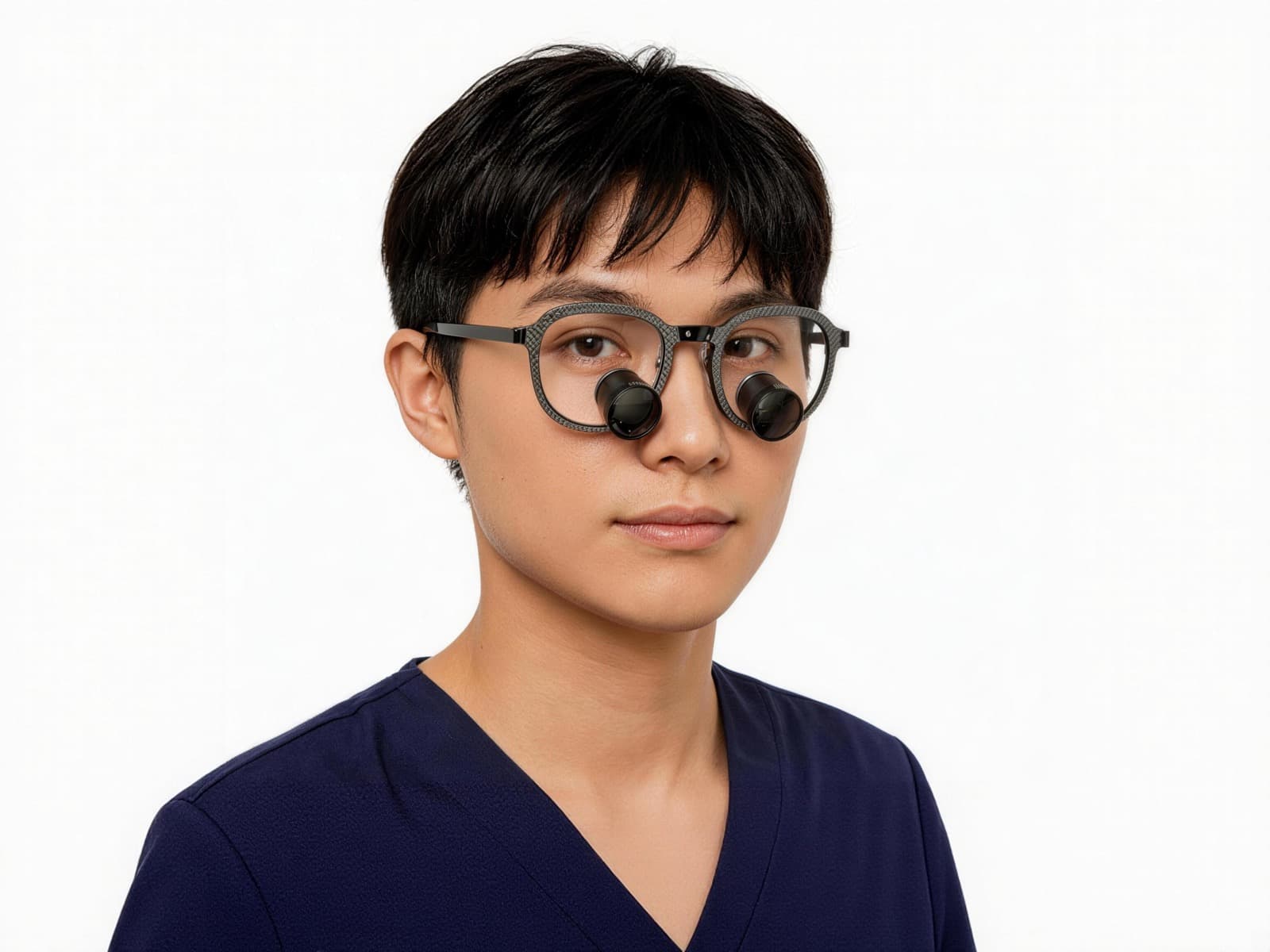
Loupes with matched parameters: the sharp zone sits right in front of your eyes when you sit upright — no bending required.
Interpupillary Distance (PD): Aligning Two Barrels with Your Two Eyes
PD is the distance between the centers of your two pupils — mostly 54–72mm in Asian adults. Binocular loupes form one image in each barrel, fused by the brain into stereoscopic vision. When the optical centers of the barrels do not match your PD, light passing through the off-center zones of the lenses creates a prism effect: the extraocular muscles compensate continuously, and eye strain, dizziness, and nausea follow.
How PD is measured
- From your prescription: if you had your eyes measured for glasses, the slip usually lists a PD — usable as a reference.
- Self-measurement in a mirror: look straight ahead, rest a ruler against the bridge of your nose, and read each pupil center — the difference is your PD. Fine for a rough screening; the error is often 2–3mm.
- Pupillometer re-measurement: done by an optometrist or the manufacturer's specialist, accurate to within 1mm — this is the number to use for customization.
One easily missed point: distance and near PD are different. The eyes converge at near, so near PD is about 2–4mm smaller than distance PD. Loupes use the near PD — measure it under the manufacturer specialist's guidance, and do not simply report the distance PD from your glasses prescription.
Working Distance: How to Choose It
Working distance is the distance from the lens to the operating field. It determines where the loupe's focus lands — in other words, where you sit and how straight your back can stay. Common levels are 340 / 420 / 460 / 500mm (grading varies slightly by manufacturer; custom models can be made anywhere in the range).
Self-measurement: sit in your standard posture, measure eye to field
- Sit on your doctor's stool at your usual height: feet flat on the floor, thighs parallel to the ground, lower back against the support.
- Ask a colleague to lie on the dental chair as the "patient," set to your most-used treatment position.
- Keep your upper body straight and upper arms hanging naturally; place both hands where you normally operate and simulate your working movements.
- Have someone measure the straight-line distance from the corner of your eye (where the lens sits) to the field with a tape — three times, then average.
What influences working distance: taller height and longer arms naturally mean a longer distance; working at the 11–12 o'clock position (directly behind the patient) is slightly shorter than at 9 o'clock; the flatter the chair, the longer the distance. The principle is report what you measure — do not bend your posture to fit a level; when in doubt, go longer rather than shorter — too short forces you to bend, slightly longer only raises your hands a little.
| Working distance | Roughly suits | Notes |
|---|---|---|
| 340mm | Petite build, close-range working style | Common among dentists who favor the 9 o'clock position and a higher chair |
| 420mm | Average build, routine general work | Where most dentists land |
| 460mm | Taller build, upright sitting posture | The back stays fully against the chair back while operating |
| 500mm and above | Tall, long-armed users, or prismatic loupe users | Paired with prismatic optics, approaches level-gaze operation |
The table is only a reference — height and working distance do not map strictly: two people both 170cm tall can differ by 60mm because of different chair habits. Measurement always beats looking up a table.
Depth of Field: The Loupe's Margin for Error
Depth of field is the range in front of and behind the focus point that stays sharp. When the patient's head shifts slightly or you adjust your posture a little, the image stays clear — that is depth of field at work.
Depth of field and magnification trade off against each other: the higher the magnification, the shallower the depth and the smaller the field. A straight-through 2.5X reaches about 200mm of depth and a field over 150mm, leaving your head plenty of freedom; high-magnification prismatic loupes at 5X–6X hold only 55–115mm of depth and a 50–75mm field (5X: 60–75mm field; 6X: 50–70mm) — positioning must be exact. That is why high magnification is more demanding about custom parameters: with so little margin for error, even slightly off parameters make the pair unwearable.
The practical implication: for a first pair and everyday general work, prefer low magnification with deep depth of field — quick to start, easy to keep wearing. Upgrade to high magnification for specialist precision work, where the demands on custom accuracy are correspondingly higher.
Frames: Materials, TTL, and Flip-Up
On materials: titanium frames are light, corrosion-resistant, and hypoallergenic; sport (wraparound) frames fit securely, resist slipping, and shield a larger area from splatter — at the cost of feeling stuffy in summer. The real dividing line is how the barrels are mounted.
TTL (through-the-lens) vs flip-up
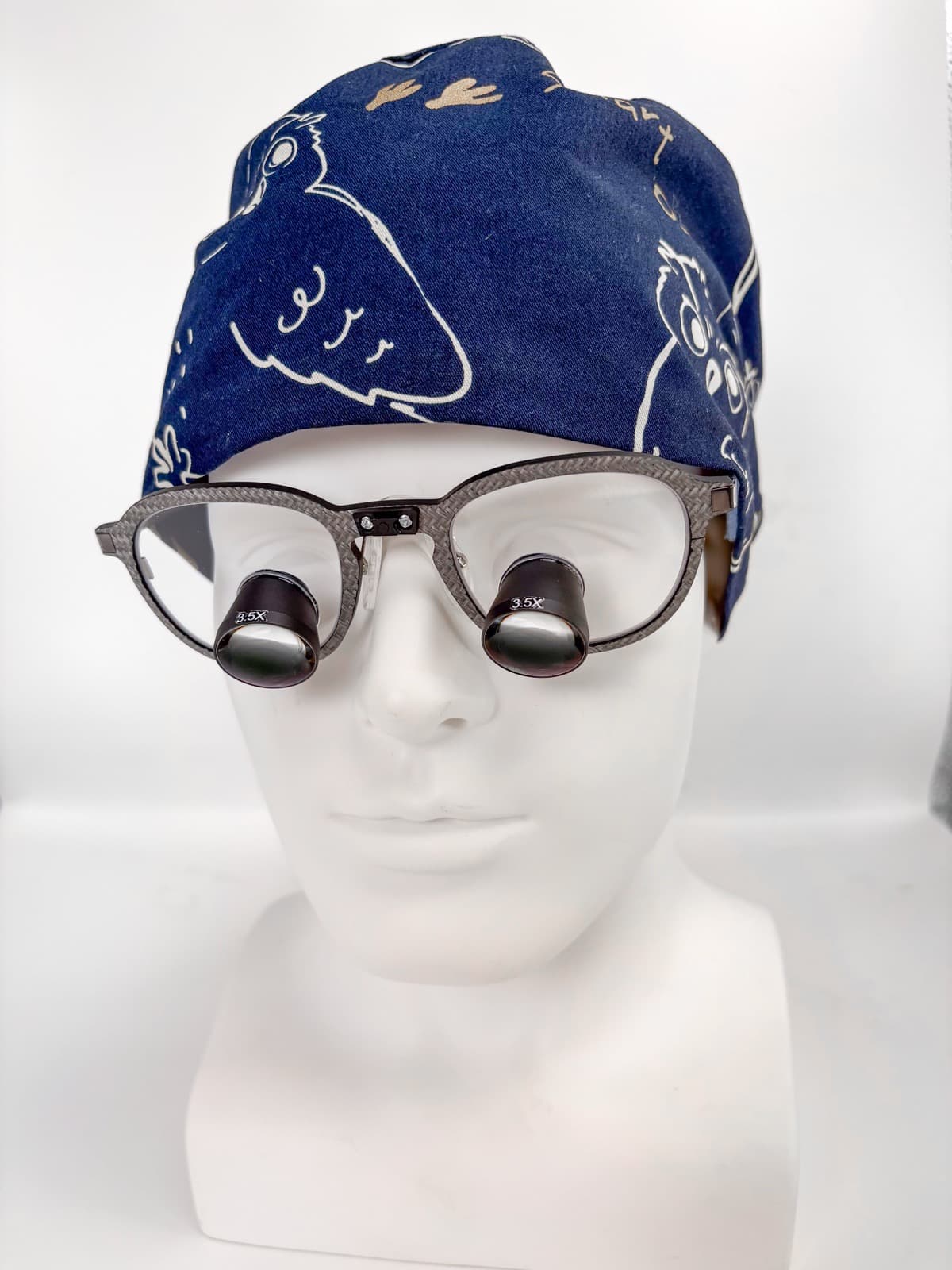
TTL mounts the barrels straight through the carrier lenses, fixed permanently to your parameters: lighter, with the best alignment between optical and visual axes, ready the moment you put it on, and with the center of gravity closest to the face. The cost is parameters that are "welded in" — PD is not adjustable, the barrels cannot flip up, talking to a patient means pushing the whole frame up or taking it off, and a changed prescription means sending it back for adjustment.
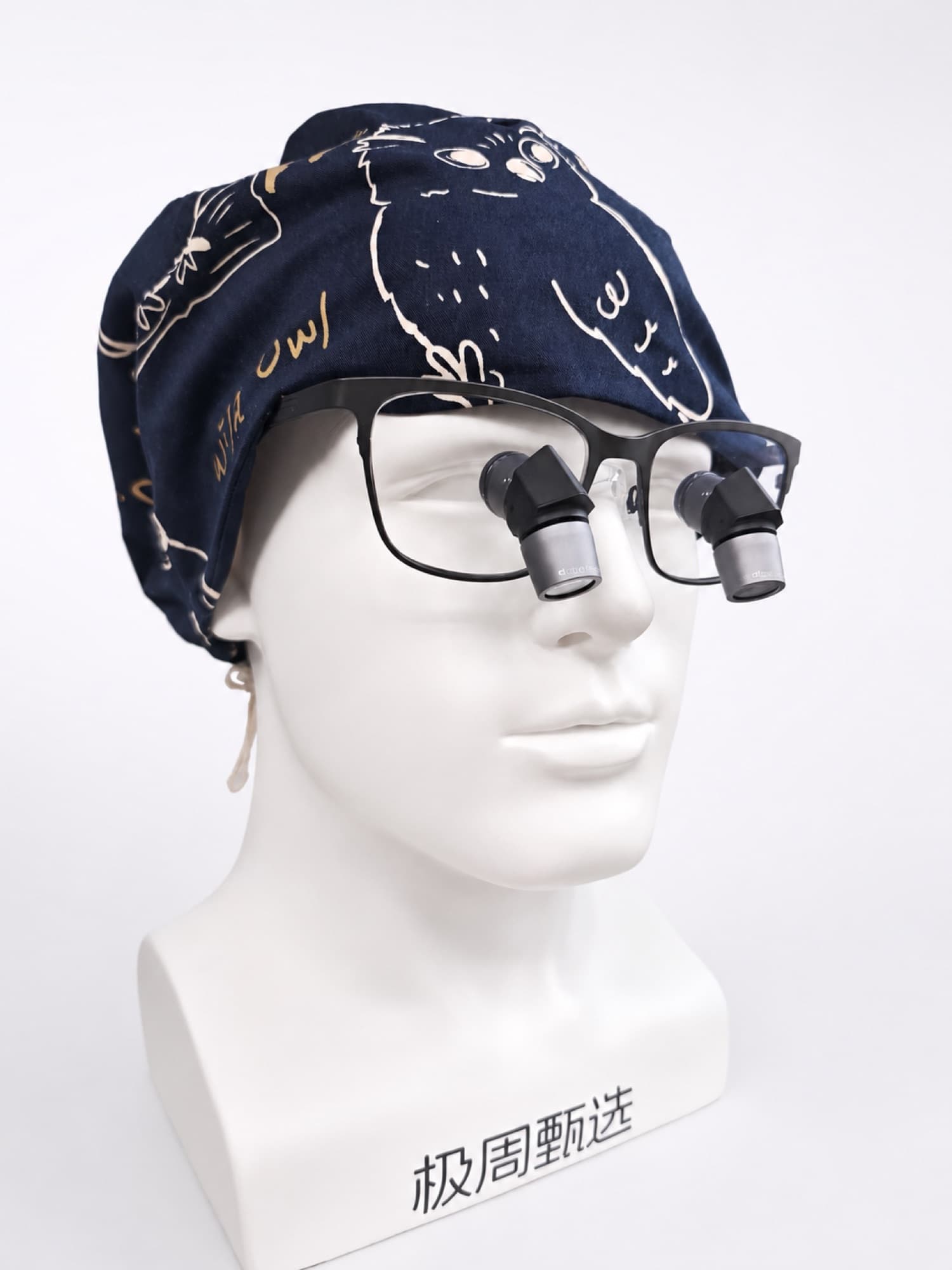
Flip-up hinges the barrels on the frame's brow bar so they can be raised: flip up to talk or write charts, and the PD is adjustable — resalable, shareable between users, and friendly for teaching. The cost is a hinge that adds weight and a risk of loosening, and each time you lower the barrels you confirm the angle has returned to its seat.
| Dimension | TTL | Flip-up |
|---|---|---|
| Weight | Lighter | The hinge adds weight |
| Coaxial alignment | Best — permanently fixed | Depends on hinge return precision |
| Talking / charting | Push the whole frame up or take it off | Just flip the barrels up |
| Parameter adjustment | Fixed, not adjustable | PD and declination angle adjustable |
| Typical scenario | A personal long-term primary pair | Teaching, multi-user sharing, frequent on-and-off |
The conclusion: for a personal first primary pair, the clinical mainstream is TTL; consider flip-up only when frequent on-and-off or shared use is a real requirement.
Myopia, Astigmatism, Presbyopia: Handling Prescription Lenses
Dentists who need vision correction have three routes. The first is contact lenses plus plano loupes: the most flexible, but wearing contacts for more than 8 hours a day brings obvious dry-eye problems. The second is prescription built into TTL: send your prescription data with the custom order, and the correction is made straight into the barrels — done once and for all, and the recommended route for high prescriptions and high astigmatism. The third is rear prescription inserts or clip-ons: flexible and swappable, but every extra lens surface adds a reflective interface and a small optical loss.
Two details deserve emphasis. With astigmatism above 100 degrees, go straight to built-in prescription — contacts correct astigmatism less stably, and the residual aberration is multiplied by the loupes. Dentists over 40 with presbyopia should report their near prescription and ADD (the add power); the manufacturer converts the power for your working distance — ordinary reading glasses are designed for 33cm, a completely different matter from a 420mm working distance. This is exactly where "custom" is irreplaceable. Use a prescription dated within the last 6 months.
The Custom Process: How One Pair Per Person Is Made
AcuView stands for "The Standard of Precision," and in product terms that means one pair per person: everyone's PD, working distance, refractive state, and face shape differ — a standard product is a compromise by definition, and customization is the correct way to make loupes. Taking ACUVIEW as an example, the full process looks like this:
- Contact us and describe your needs and clinical scenarios. Our specialists recommend the most suitable configuration and provide a one-on-one quote.
- A specialist guides you through measuring PD, working distance, and prescription over a video call, and confirms every parameter with you.
- Your loupes are custom-built to those parameters — usually 2–3 business days.
- Worldwide shipping, with our team available for follow-up fit questions after delivery.
Because every pair is made to personal parameters, the measurement step is the quality gate: our specialists walk you through each number before production starts, so the finished pair fits the first time.
From order to delivery is usually about a week (2–3 business days of custom work plus international shipping). Custom products are made for you alone, so returns without reason are not supported — which is exactly why confirming parameters carefully up front matters.