Optical Principles: Two Loupes, Two Light Paths
The difference between straight-through and prismatic loupes is not cosmetic — it is the path light takes inside the barrels. Understand this, and every comparison that follows falls into place.
Straight-through: a Galilean path, sight travels straight
Straight-through loupes use the classic Galilean design: a concave lens paired with a convex lens, sending light into your eyes along the original direction of your gaze. The upsides are direct — a simple structure, so they are light, transmit more light, offer a wider field of view, and cost less. The trade-off is equally direct: wherever the barrels point is where your eyes must look. To see the operating field below, your head has to tilt down. Straight-through loupes ease the posture problem by extending the working distance (customizable from 300–700mm), so you no longer work nose-to-patient — but the downward tilt itself remains, just smaller.
Prismatic: prism deflection, sight takes a turn
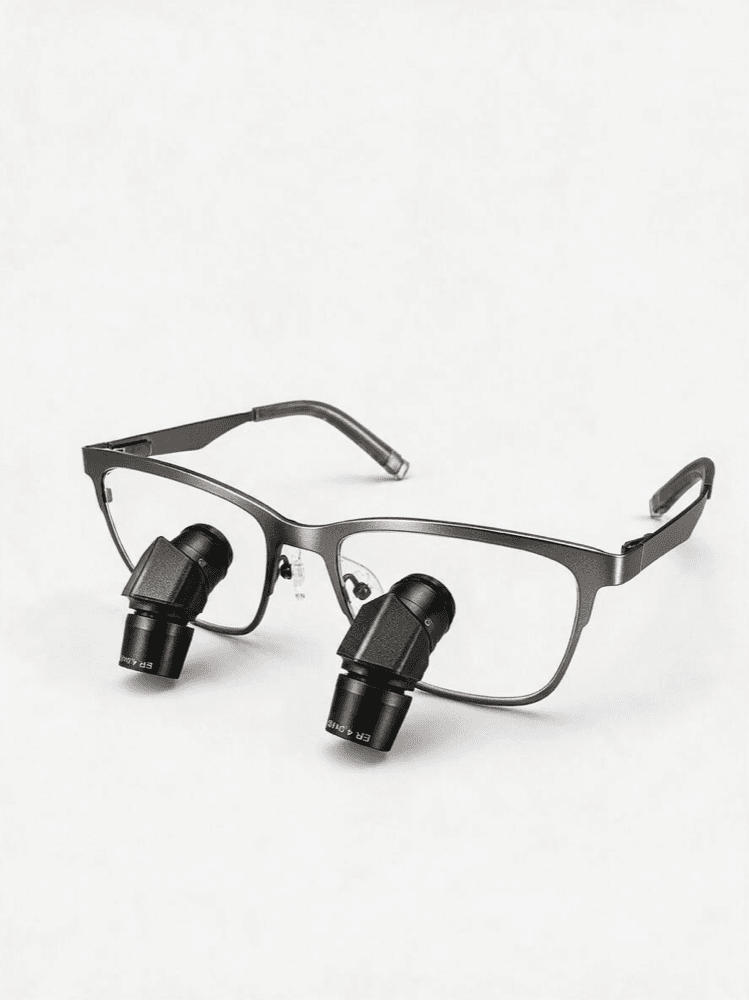
Prismatic loupes add a prism group inside the barrels that deflects light from the lower operating field by roughly 40–45° before it reaches your eyes. The result: your eyes look straight ahead while the barrels "watch" the teeth below for you. The head and neck stay near neutral, with no sustained forward flexion. The extra optics come with three costs: more weight, a higher price, and a smaller field of view at the same magnification — every prism surface consumes a little light and a little field.
In one sentence: with straight-through loupes you adapt to the optics; with prismatic loupes the optics adapt to you. Neither is more advanced — the question is which one you need more at this stage.

Why Prismatic Loupes Let You Work with a Straight Neck
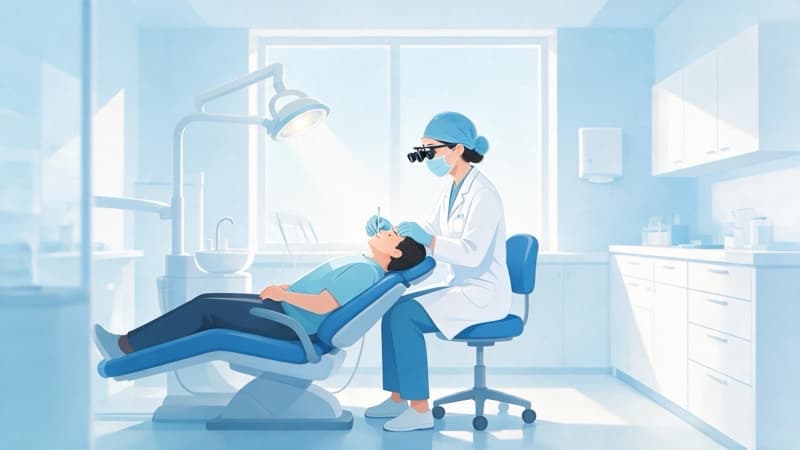
Working with the naked eye forces a trade: to resolve millimeter-level detail, your eyes must get close to the field, and forward cervical flexion becomes a physical necessity. Survey data shows 82.4% of dentists suffer from musculoskeletal disorders (n=614), with sustained forward flexion among the leading causes. Straight-through loupes extend the working distance and keep the head tilt small; prismatic loupes go further — the optics look down for you, the cervical spine stays near neutral, and the neck and shoulder muscles no longer hold a continuous isometric contraction. For a dentist practicing 6–8 hours a day, this difference compounds over years into the difference between "still able to work clinically" and not.

Straight-Through vs Prismatic: Six Dimensions Compared
| Dimension | Straight-through (Galilean) | Prismatic (prism optics) |
|---|---|---|
| Optical principle | Light enters the eyes in a straight line; the barrels point where you look | Prisms deflect the lower field by about 40–45°; a level gaze looks down |
| Common magnifications | 2.5X / 3.5X | 4X / 5X / 6X |
| Field of view | 150–170mm (2.5X), 110–130mm (3.5X) | 70–95mm (4X), 60–75mm (5X), 50–70mm (6X) |
| Depth of field | About 200mm — the image stays clear as your head moves | 55–115mm — head position must be steadier |
| Weight | About 43g | 51–54g (heavier at higher magnification) |
| Price | Entry tier | Flagship tier |
| Learning curve | Almost zero adaptation; clinical use on day one | About 1–2 weeks of adaptation while spatial sense rebuilds |
| Posture impact | Head still tilts, but far less than with the naked eye | Cervical spine near neutral — the lowest neck and shoulder load |
Two rows of the table deserve a closer look. The first is field of view: straight-through loupes are noticeably wider, so your peripheral vision catches more of the surrounding field and instruments are located faster — most of their beginner-friendliness comes from here. The second is the learning curve: spatial sense has to be rebuilt with prismatic loupes, and nearly everyone feels their hands outrun their eyes in the first days. It usually disappears within one to two weeks — no need to worry.
Which One Fits You: Match by User Profile
First pair / dental students → straight-through
Your working habits are still forming and your fundamentals are still in training. A wide field, a low price, and zero adaptation make straight-through the safe answer — the cost of a wrong entry-level choice is far lower than regretting a prismatic one.
General dentists (mostly exams, prophylaxis, routine restorative) → straight-through
The precision demands of daily procedures are fully covered within 3.5X, and a wider field is more efficient when scanning the full arch or changing quadrants during prophylaxis. Straight-through is the sweet spot for exactly these scenarios.
Endodontics → prismatic 4X–5X
Pulp chamber roofs, canal orifices, and calcified canals demand 4X and above — and root canal treatment happens to be the most neck-punishing procedure, with the head held down in a fixed posture for half an hour at a time. Both magnification and posture point to prismatic.
Precision restorative → prismatic 4X–5X
Shoulders, margin lines, and proximal contacts — the details that decide how long a restoration lasts all live at the sub-millimeter level. Prismatic loupes let you deliver that precision steadily in an upright posture, as consistent in the afternoon as in the morning.
Periodontal surgery / surgical procedures → prismatic 5X–6X
A small surgical field, extreme precision requirements, and a relatively fixed standing position — surgical scenarios are the least sensitive to field loss and the most sensitive to detail and posture. This is the classic profile of a high-magnification prismatic user.
Experienced dentists whose neck already hurts → prismatic
If your neck no longer feels like your own by the end of the day, the top priority is not magnification — it is posture. In this situation a prismatic loupe is not a consumer upgrade; it is career insurance.
Three Questions, 30 Seconds to Your Answer
Skip the theory? Answer the three questions below and follow the arrows: