Buying Guide
How Long Do Dental Loupes Last? Lifespan, Care, and Whether Refurbished or Used Loupes Are Worth It
2026-10-29 · Jizhou Select
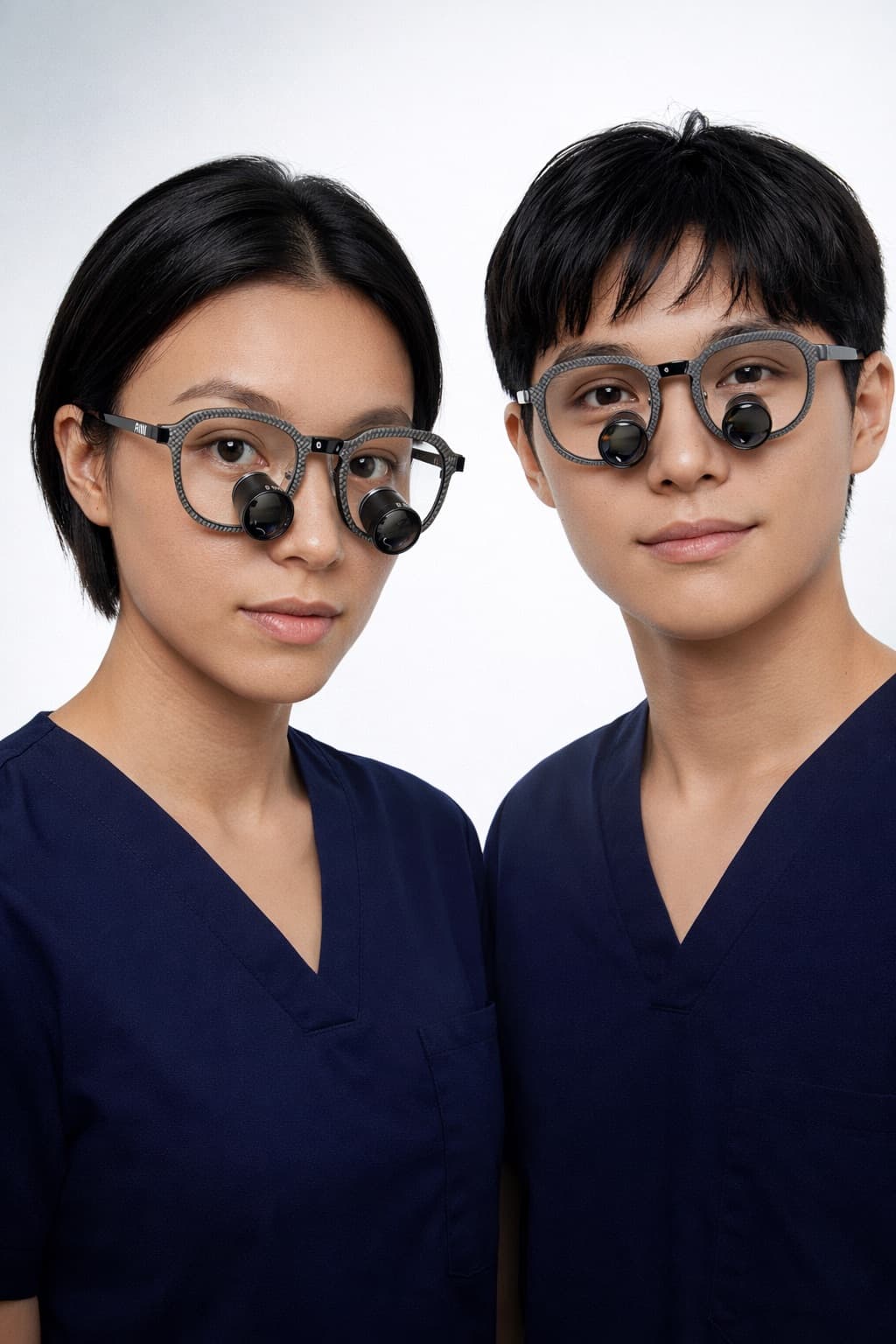
The lifespan of dental loupes is not measured in years. If the lenses are not scratched, the frame is not bent, and the custom parameters still match your current working distance, a pair of loupes can serve you clinically for many years. What tends to expire first is wear parts such as batteries—and the fact that your parameters no longer fit. So whether refurbished or used loupes are worth it does not come down to price. It comes down to whether the parameters match and whether the condition can be verified.
Lifespan has three layers: optics, frame, and electronics
Optics and barrels. The lenses are A+ grade optical lenses and the barrels are aluminum alloy. The lenses themselves are disinfectant-resistant. What this layer fears is impact and rough cleaning, not time.
Frame. Titanium alloy or carbon fiber. The straight-barrel complete unit weighs about 43 g; the angled 4X/5X/6X models weigh about 51 g/53 g/54 g respectively. Light weight is an advantage, but it also means the loupes are not suited to being tossed into the bottom of an instrument tray under pressure.
Electronics. With a headlight, LED life is 100,000 hours, battery life is ≥700 charge/discharge cycles, runtime is 2 hours per battery, fast charging takes 1 hour, and the kit includes three batteries for rotation. At one battery cycle per day, 700 cycles is a figure measured in years—the LED is not the weak point; the battery is what will degrade first.
There is one more layer: some custom products carry a warranty starting at 12 months, covering quality issues not caused by human factors.
Care is less about polishing and more about avoiding three things
First, do not dry-wipe. The lenses are disinfectant-resistant, but the surface is vulnerable to particles trapped between the cloth and the lens. Rinse the particles away first, then wipe. This saves a large number of scratches.
Second, do not leave the frame under long-term stress. The barrels and frame determine whether the optical path is accurate. Once they are squeezed out of shape, both the image and the wearing position will change with them.
Third, do not store headlight batteries long-term in a depleted state. The batteries are designed for ≥700 charge/discharge cycles. Three-battery rotation covers a full clinic day, and that is itself a way to slow degradation.
When to replace rather than repair
Three signals are worth watching. First, your working distance or refraction has changed, and the custom parameters no longer match. Second, the lenses have scratches that affect the image. Third, a non-human quality issue has appeared—within the warranty period, you can get a free return or exchange with evidence, and the seller bears the shipping cost. One reminder: improper measurement is not a quality issue. Measuring pupillary distance and working distance correctly at the start is cheaper than fixing things afterward.
Refurbished or used loupes: ask three questions first
One: do the parameters match? Loupes are made one person at a time. Pupillary distance, working distance, and refraction are all customized. Pupillary distance commonly ranges from 54–72 mm, and working distance is tiered from 340 mm to 500 mm and above. Someone else’s 420 mm may not be your measured point. The official position is direct: one wrong parameter can wipe out the ergonomic benefit entirely, or even turn it negative. The most expensive part of buying used is that the money you save may buy you parameters that do not fit you.
Two: can the condition be verified? Whether the lenses are scratched, whether the frame is deformed, and how far the headlight battery has been cycled—none of this can be seen in photos.
Three: is after-sales support still there? A warranty starting at 12 months applies to custom orders. Whether a used item can continue that coverage depends on the original order and the seller. Custom products also do not support unconditional returns or exchanges for non-quality issues, which means used transactions carry a higher risk that the sale is final.
The conclusion is simple: parameters match, condition can be verified, and the price is clearly below a new custom order—only when all three conditions hold can used loupes be worth it. If one is missing, they are not.
FAQ
How many years can a pair of loupes actually last? The official website makes no year-based commitment. What is certain is this: passive parts such as lenses, barrels, and frames have no “expiration” setting; the headlight LED is rated at 100,000 hours and the battery at ≥700 charge/discharge cycles. How long they actually last depends on your habits of use and storage, and on whether your working distance has changed.
What should I do if the battery degrades? The kit is 1 headlight + 3 batteries + charging base, with wireless magnetic quick-release, so you can change the battery without removing the loupes. The battery is the first item to watch; the headlight body lasts far longer than the battery.
Can a 5-day trial verify durability? No. The trial starts the day after delivery and verifies fit, field of view, and posture comfort—not durability. Durability depends on the warranty and daily care.
Used loupes are half price. Are they worth it? Only if pupillary distance, working distance, and refraction happen to match yours, and the lens condition can be verified. Otherwise, the money you save is paying for a mismatch.
Do you sell refurbished units on the official website? The product pages currently present custom new products, and there is no refurbished-unit category listed. For current availability, contact our support team directly and rely on their guidance.