Buying Guide
How to Choose Your First Dental Loupes as a Student: Budget Path and the Good-Enough Principle
2026-10-15 · Jizhou Select
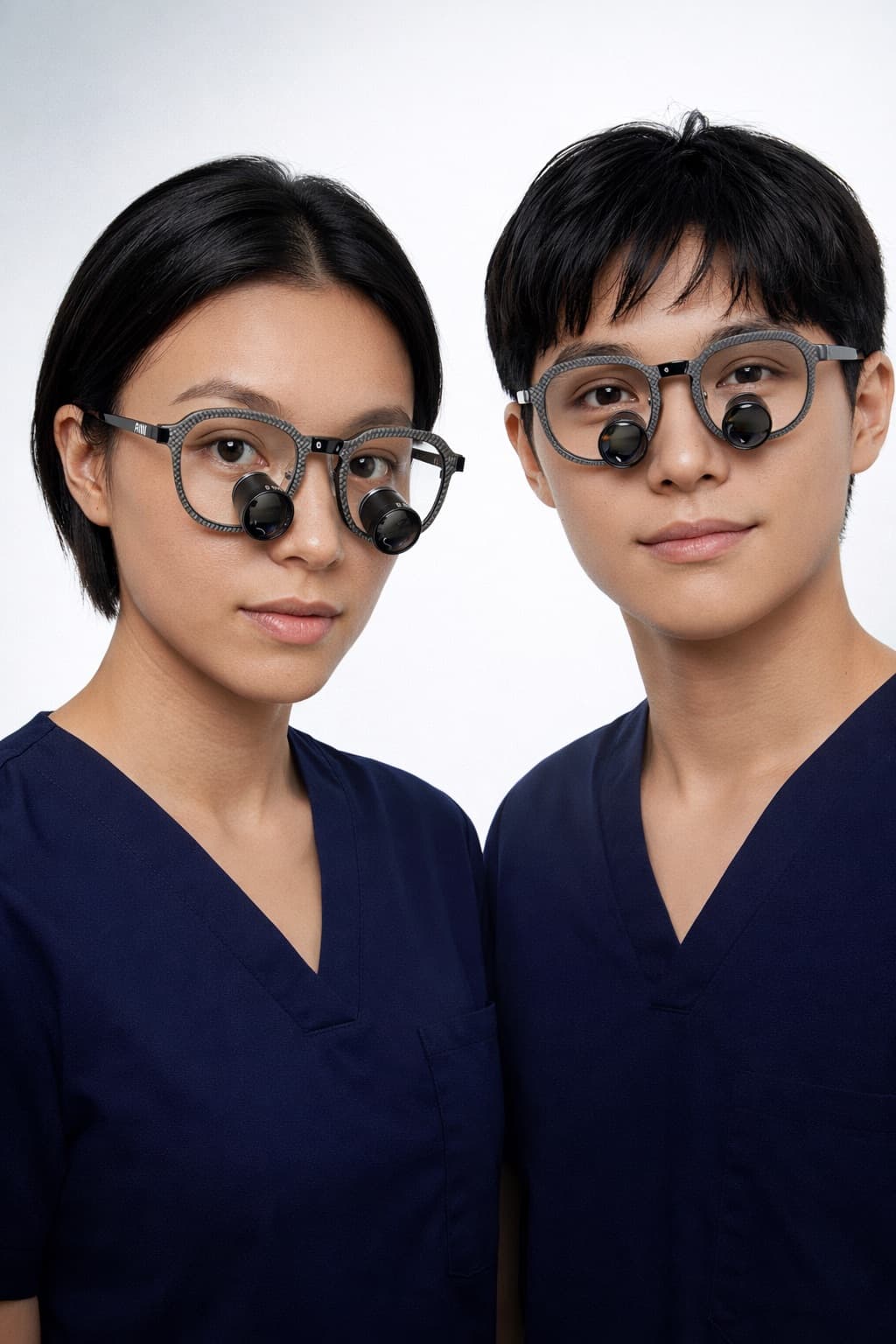
If you're a dental student choosing your first pair of loupes, here's the conclusion up front: choose straight optics, start at low magnification, and have them custom-built to your own interpupillary distance and working distance. 2.5X is enough to carry you through your entire training. Put your money into something you'll actually keep using, not into the spec sheet. The reasoning and the roadmap are below, point by point.
Choosing the optical path and magnification for your first pair: straight first, low magnification first
Straight and angled loupes aren't a low-end versus high-end distinction — they're two different optical designs. With straight optics, you adapt to the loupes; with angled optics, the loupes adapt to you. At the student stage, the most important thing is not letting your equipment disrupt what your hands are already doing.
- Learning curve: straight optics have virtually no adaptation period — you can be in clinic the same day. Angled optics take about 1-2 weeks to adapt to, requiring you to rebuild your spatial sense; nearly everyone gets that awkward feeling in the first few days of "hands moving faster than eyes."
- Field-of-view tolerance: 2.5X gives a 150-170mm field of view and 200mm depth of field — a wide view with plenty of tolerance for error. Angled optics start at 4X, which narrows the field to 70-95mm and demands far more precision in positioning.
- Case coverage: 2.5X corresponds to general exams, scaling, and medical student practice. The official positioning line is "covers 80% of everyday dental procedures — the safe starting point for a first pair of loupes."
The product manager's advice is refreshingly practical: "With your first pair, don't try to solve everything at once — just aim for something you'll actually keep using. Start at low magnification: the field of view is wider and easier to adapt to. Choose straight optics so you don't have to change your existing working habits — you'll get up to speed faster."
The good-enough principle: get one of three parameters wrong and you've wasted your money
Loupes must be custom-built to three parameters: interpupillary distance, working distance, and refractive error. Get one wrong and the ergonomic benefit drops straight to zero — or turns negative.
- Interpupillary distance: most Asian adults measure 54-72mm, and the 25AV-ST supports custom builds from 54-72mm. A prescription slip is only a reference; measuring yourself in the mirror carries 2-3mm of error. Custom builds are based on a remeasurement with a pupillometer (accurate to within 1mm).
- Working distance: sit in your standard posture, have a colleague lie back in the chair to simulate a patient, keep your upper body upright with both hands over the treatment area, and measure the straight-line distance from the corner of your eye to the treatment area. Take three measurements and use the average. Report exactly what you measure — don't fudge it to fit a stock option, and err on the long side rather than the short side. Common settings are 340/420/460/500mm, and your setting is confirmed by measurement during the try-on.
- Refractive error: myopia, astigmatism and hyperopia can all be built into the prescription, so there's no "glasses over glasses" stacking.
The frames are titanium alloy/carbon fiber, the complete unit weighs about 43g, and frame engraving is included at no charge.
Budget path: spend your deposit on the try-on, not the spec sheet
The official site doesn't publish prices. Instead, you submit a try-on request and a consultant quotes you one-to-one based on your configuration. So the core of the budget path isn't comparison shopping — it's validate first, pay later.
The 5-day free try-on is counted from the day after delivery. You can request a 2-3 day extension; beyond that there's a ¥50 per day holding fee, capped at ¥300. The loupe deposit is ¥3,000. If you're not satisfied, ship them back and the full deposit is refunded within 48 hours of the returned product being received. Custom builds usually take 2-3 business days.
The process is four steps: ① Describe your needs and use case to our team, and an assistant recommends a brand and parameters. ② Confirm the plan and pay the deposit to begin the custom build. ③ Once it arrives, try it out in your daily work during the 5-day try-on window. ④ Pay the balance if you're happy; if not, ship it back for a full deposit refund. After purchase, send your parameters — interpupillary distance, working distance and so on — to the Jizhou Select team.
Should you add a headlight right away?
The priority for your first pair is getting the loupes themselves right. If you later move to higher magnification (4X and above), light transmission drops, and the official recommendation is to pair the angled Pro model with a light. If you're only doing low-magnification straight optics, you can leave the light for later. The headlight deposit is ¥1,000; the light head weighs 11.1g and the complete unit 28g, with 40,000 LUX illuminance, CRI 90+, and a 5800K color temperature.
One thing worth clarifying: what loupes improve is your working posture and how tired you feel
Zhang Ping et al. 2021 (n=614), a cross-sectional survey, found the overall 12-month prevalence of musculoskeletal disorders among dental professionals was 82.4%, with the neck leading at 75.2%. This is background on the state of the profession, not evidence of product effectiveness.
The mechanism behind the postural benefit: to see millimeter-level detail with the naked eye, you have to lean close to the treatment area, which makes forward cervical flexion a physical inevitability. Loupes extend the working distance from roughly 20cm to 35-55cm, letting the head and neck return to a neutral position. Straight optics still require you to look downward, but a custom long working distance turns "leaning in close to see" into "a slight forward incline" — and combined with an upright seated posture, that eases the load on neck and shoulders. Separately, schedule at least 5-10 minutes of rest for every 45-60 minutes of treatment.
FAQ
1. Will 2.5X stop being enough very quickly? Most student-stage work is exams, scaling and basic restorative, where the field of view and depth of field of 2.5X are more forgiving. Once your case mix has stabilized and you've clearly moved toward endodontics or precision restorative work, then consider 3.5X or angled 4X. You don't have to solve everything with your first pair.
2. Can I skip the try-on and just order to my measurements? Not recommended. All three — interpupillary distance, working distance and refractive error — need to be measured: PD is based on a pupillometer remeasurement, and working distance has to be confirmed by measurement. The 5-day try-on, counted from the day after delivery, is how you verify in your daily work that this configuration actually fits your hands.
3. If I'm not satisfied after the try-on, is the deposit refundable? Yes. Ship it back and the full deposit is refunded within 48 hours of the returned product being received. The loupe deposit is ¥3,000; the try-on can be extended by 2-3 days on request, with a ¥50 per day holding fee beyond that, capped at ¥300.
4. I'm nearsighted or have astigmatism — do I need an extra pair of glasses? No. Myopia, astigmatism and hyperopia can all be built into the prescription, customized to your refractive parameters.
5. If I choose straight optics first, is switching to angled later a waste? No. They're two different optical designs, and straight optics remain highly usable for low-magnification exams and everyday procedures. Plenty of clinicians start with straight optics to build magnification habits, then add an angled pair for specific situations.