Buying Guide
TTL vs Flip-Up Dental Loupes: How to Choose, and the Three Costs to Weigh
2026-10-22 · Jizhou Select
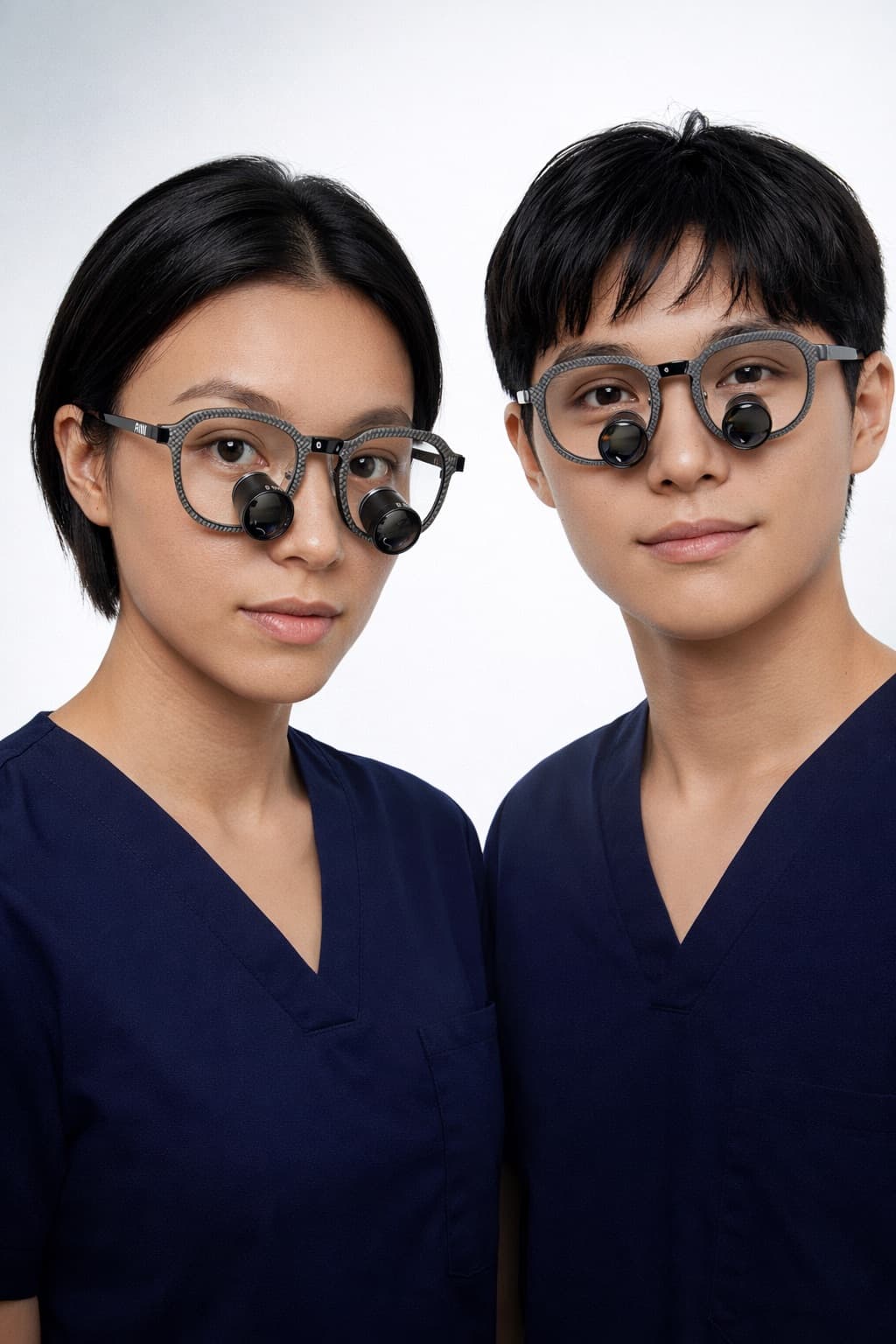
If the loupes will only ever serve you, go with a TTL custom build. If they'll be shared around the practice by several people, or you often need to flip the barrels up and work with the naked eye, flip-up is the better fit. The difference between the two isn't the optical path — it's how the barrels attach to the frame. Get that layer straight and the rest of the math gets easier.
TTL vs Flip-Up: The Difference Is the Mount, Not the Optics
TTL locks the barrels and lenses into a single unit built to your pupillary distance, working distance and prescription; flip-up (flip-up) barrels can be tilted upward. Both are simply frame formats, and both are separate questions from "straight versus angled" — the official position is clear: straight and angled are not a low-end versus high-end relationship but two optical path structures, where straight means "you adapt to the loupes" and angled means "the loupes adapt to you." So the selection order should be: decide the optical path first, then the magnification, and only then the frame format.
Cost #1: How Many People Will Wear These Loupes
The official site puts "one person, one pair" among its three principles: pupillary distance, working distance and face shape are all customized per person, with no standard sizing. TTL parameters are written for one individual — pupillary distance 54-72mm, working distance by measured step, and myopia, astigmatism and hyperopia available as built-in prescriptions. Put the same loupes on someone else and the parameters no longer match; the buying guide's own wording is that "get one parameter wrong and the ergonomic benefit drops straight to zero — or turns negative."
If your scenario is one pair rotating among several people, teaching demonstrations, or needing to flip up to talk with a patient or assistant, that's where flip-up belongs. But one thing needs saying plainly: being able to flip up does not mean fitting every wearer — pupillary distance and working distance don't align themselves just because the barrels can tilt.
Cost #2: Can You Actually Complete the Custom Process
Customization isn't filling in a form. Working distance has to be self-measured: standard seated posture, a colleague lying in the chair to simulate, torso upright, both hands at the treatment site, measure the straight-line distance from the corner of your eye to the site, take three measurements and average them; report exactly what you measure, and err longer rather than shorter. The common steps are 340mm (smaller build or habitually working from the 9 o'clock position), 420mm (where most dentists land), 460mm (taller build, upright seated posture), and 500mm or more (very tall dentists or angled-loupe users). Pupillary distance is confirmed by pupillometer re-measurement, within 1mm.
Once these steps are done, TTL customization holds up. If flip-up follows the universal-spec route, that step doesn't exist — and neither does the corresponding slice of ergonomic benefit.
Cost #3: How Trial and After-Sales Work Out
The 5-day free trial counts from the day after delivery, and you can request a 2-3 day extension; beyond that there is a CNY 50 per day occupancy fee, capped at CNY 300. The loupe deposit is CNY 3,000, and you can trial 2 brands at the same time, CNY 3,000 per brand. If you're not satisfied, send them back — the deposit is refunded in full within 48 hours of the returned product being received. Customization usually takes 2-3 business days to complete.
One caveat: custom products are not eligible for no-reason returns or exchanges where there is no quality issue, and a poor measurement does not count as a quality issue. The trial window is only 5 days, so spend it on "one person's normal clinic day" — if you've already settled on shared use, think that through in advance. Prices are not published on the official site; a consultant quotes one-to-one according to configuration, so don't guess at expensive or cheap from the frame format.
An Order You Can Actually Follow
Step one, choose the optical path by procedure: for daily examinations, scaling and routine restorative work, straight has almost zero adaptation and can go into clinical use the same day; if you already have loupe experience, carry noticeable neck and shoulder load, and want long-term posture management, angled needs roughly a 1-2 week adaptation period and a rebuild of spatial sense. Step two, choose magnification by need, remembering that magnification, field of view and depth of field trade off against one another. Step three, only then weigh TTL against flip-up. Also worth noting: the angled Pro loses light throughput at high magnification, and the official recommendation is to pair it with a headlight.
FAQ
Are TTL loupes always more expensive than flip-up? The official site doesn't publish list prices — after you submit a trial request, a consultant quotes one-to-one according to configuration. Price follows magnification, frame material and prescription customization, so it's not something to judge by frame format.
I wear glasses for myopia — can either format be made for me? Both the AcuView straight and the angled Pro support built-in prescriptions for myopia, astigmatism and hyperopia; confirm the parameter details through the specialist service process before ordering. Whether to build the prescription in depends on whether you normally prefer to work wearing your own glasses.
Two people sharing one pair — is flip-up enough? Flip-up solves "can the barrels tilt up," not "does this fit your face." Two people will most likely have different pupillary distances and working distances, so when a pair is shared, at least one of you has to accept a compromise on parameters.
Is 5 days enough to decide? Usually yes. Use the trial at your normal clinic pace and focus on neck and shoulder load and how well your vision adapts. If you're genuinely unsure, you can request a 2-3 day extension.
How long does customization take? It's usually completed in 2-3 business days.