Health Self-Assessment · Exercises

Stretching & Strengthening for Dentists

10 exercises targeting the four most strain-prone areas: neck, shoulders, lower back, and wrists. Filter by setting: 2 minutes chairside, 5 minutes in the break room, 10 minutes at home.

10 Minutes a Day

Pick One You Can Do Right Now

Steps, duration, and setting are marked on each card. Stretch only to a mild pulling sensation — never chase pain.

10 exercises

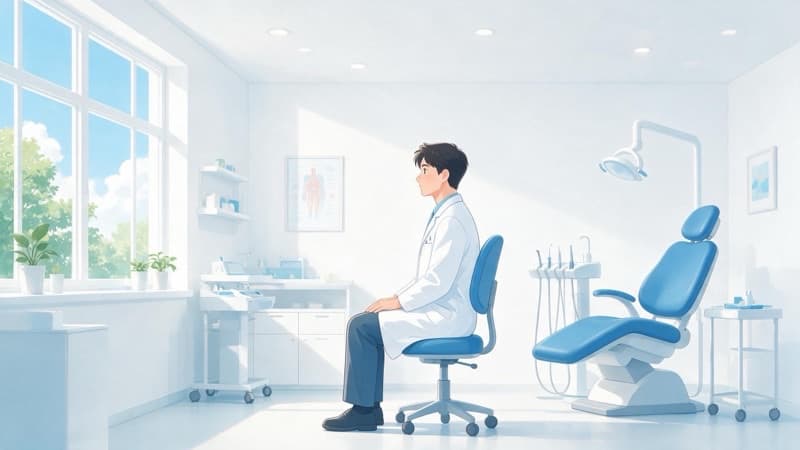
Correct Seated Posture Demo

Correct Seated Posture Demo

ChairsideLower Back2 min
  1. Sit fully back on the seat with your back against the chair back.
  2. Maintain the natural lumbar lordosis; place a small cushion behind your lower back if needed.
  3. Keep hips, knees, and ankles at roughly 90-110°, with both feet flat on the floor or a footrest.
  4. Keep the head and neck neutral and shoulders relaxed and lowered; hold for 30 seconds.

Adjusting your own posture before treatment is the foundation of all fine work.

Upper Trapezius Stretch

Upper Trapezius Stretch

ChairsideShoulders2 min
  1. Sit upright and hold the edge of the seat with one hand to anchor the shoulder.
  2. Tilt your head to the opposite side, turning slightly toward the armpit.
  3. Hold for 15-30 seconds, then switch sides.

Ideal for relieving upper trapezius tension after prolonged shrugged-shoulder work.

Scapular Retraction

Scapular Retraction

Break RoomShoulders5 min
  1. Sit or stand upright with arms hanging naturally.
  2. Imagine pinching a pencil between your shoulder blades; squeeze them back and down.
  3. Hold for 5 seconds, then slowly release.
  4. Repeat 10-15 times.

Strengthens the middle and lower trapezius, improving rounded shoulders and forward scapular posture.

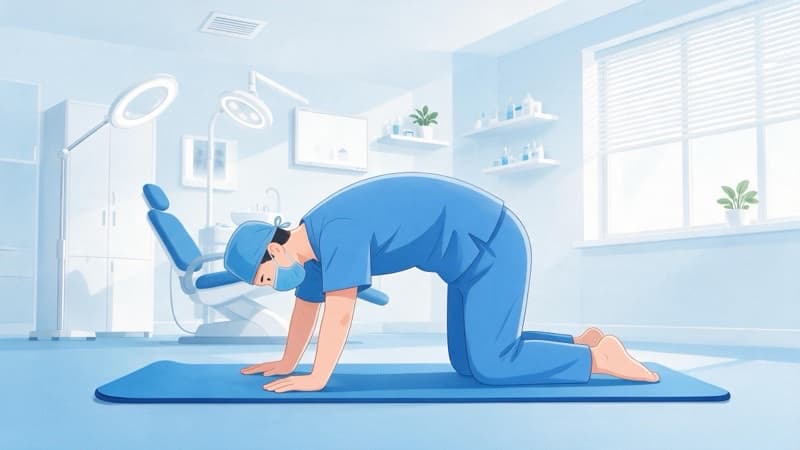
Cat-Cow Spinal Mobilization

Cat-Cow Spinal Mobilization

Break RoomBack5 min
  1. Start on all fours, wrists under shoulders and knees under hips.
  2. Inhale: drop the belly and lift the head (Cow).
  3. Exhale: arch the back and lower the head (Cat).
  4. Alternate slowly 10 times.

Increases thoracic and lumbar mobility, relieving lower-back stiffness from prolonged sitting.

Piriformis / Glute Stretch

Piriformis / Glute Stretch

At HomeLower Back5 min
  1. Lie on your back, bend one knee, and place that ankle on the opposite thigh.
  2. Hold the lower thigh with both hands and gently pull it toward your chest.
  3. Hold for 20-30 seconds, then switch sides.

Relieves glute and lower-back tension from prolonged sitting.

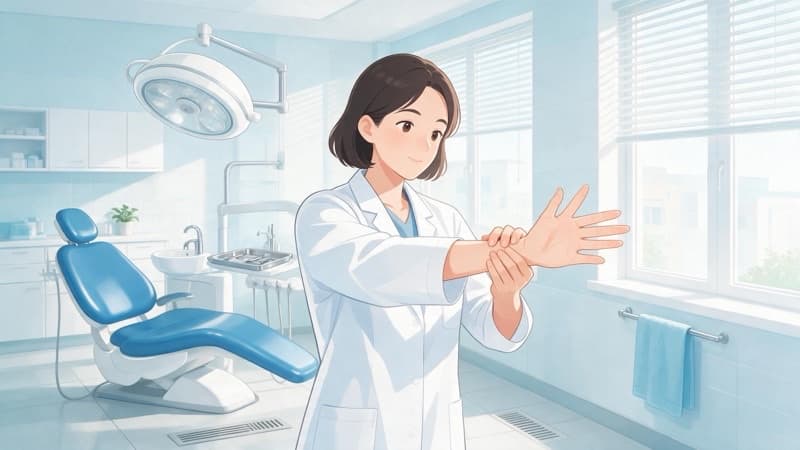
Wrist Flexor Stretch

Wrist Flexor Stretch

ChairsideWrist2 min
  1. Extend your arm with the palm facing forward.
  2. Use your other hand to gently pull the fingers toward your body.
  3. Hold for 15-30 seconds.
  4. Then turn the palm down to stretch the wrist extensors.

Ideal for relaxing the forearms after prolonged instrument gripping.

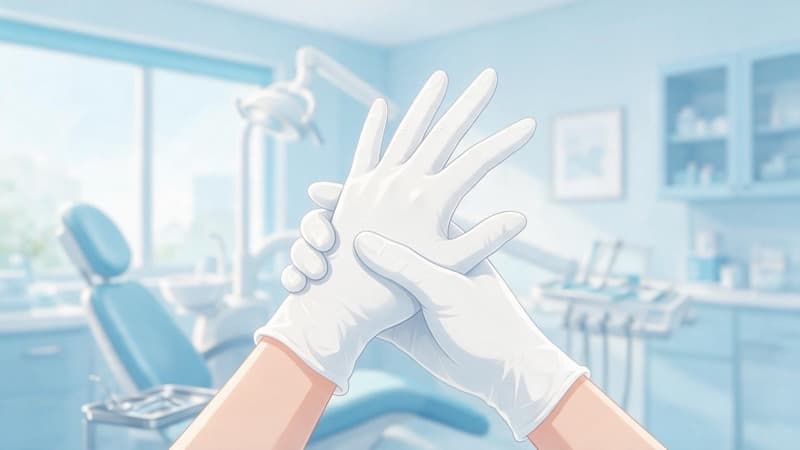
Finger Tendon Gliding

Finger Tendon Gliding

ChairsideFingers2 min
  1. Start with fingers fully extended.
  2. Bend the proximal interphalangeal joints, then the distal joints, and finally make a fist.
  3. Hold each position for 2-3 seconds; repeat 10 times.

Promotes tendon gliding in the fingers and helps reduce the risk of tenosynovitis.

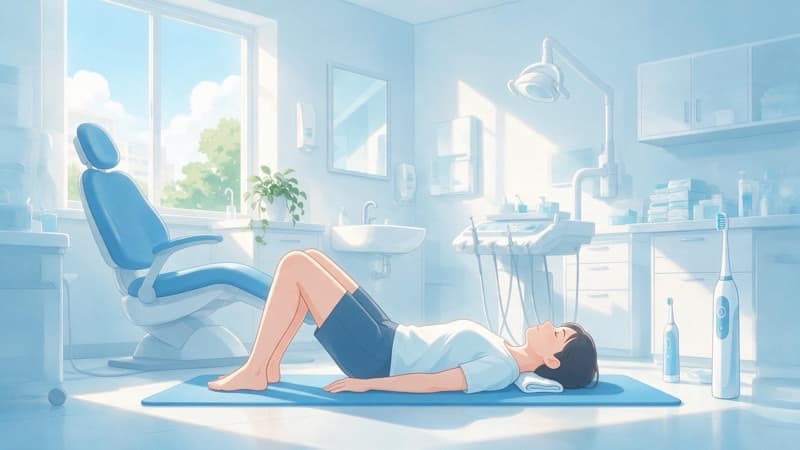
Deep Neck Flexor Training

Deep Neck Flexor Training

At HomeNeck10 min
  1. Lie on your back with knees bent and a thin pillow under your head.
  2. Gently tuck your chin so the back of your head lifts slightly off the surface.
  3. Hold for 5 seconds, then relax.
  4. Repeat 10 times.

Strengthens the deep neck flexors and improves forward head posture.

Doorway Chest Stretch

Doorway Chest Stretch

At HomeShoulders / Chest5 min
  1. Place your forearm vertically against a door frame, elbow at shoulder height.
  2. Lean your body slightly forward until you feel a stretch across the front of the chest and shoulder.
  3. Hold for 20-30 seconds, then switch sides.

Improves rounded shoulders caused by prolonged forward arm reach.

Seated Trunk Rotation

Seated Trunk Rotation

ChairsideBack2 min
  1. Sit upright with arms crossed over your chest.
  2. Slowly rotate your upper body to one side, keeping the pelvis stable.
  3. Hold for 10 seconds, then switch sides; 3 times per side.

Relieves thoracic stiffness from prolonged fixed postures.

A Realistic Way to Fit It In

Chairside · 2 min

A full set fits in the gap between two patients — no change of location needed. Weave it into every workday.

Break Room · 5 min

Do a set at lunch. Combined with leaving the operatory and changing posture, it's a key step in interrupting fatigue accumulation.

At Home · 5-10 min

Finish before bed, focusing on strengthening and deep stretching. Keep it up for at least two weeks, then reassess your symptoms.

Note: If you are in an acute pain episode, or have been diagnosed with a condition such as disc herniation or carpal tunnel syndrome, consult a physician or rehabilitation therapist before starting. If pain worsens, or you feel numbness or dizziness during an exercise, stop immediately and seek medical care. If symptoms show no improvement after two weeks or gradually worsen, get evaluated at a licensed medical facility.

Equipment Is a Key Piece

Stretching Relieves Symptoms; Equipment Reduces the Causes

Ten minutes of daily stretching relieves accumulated tension, but if you still bend down, squint, and lean in during the day, strain keeps rebuilding. Loupes and headlights answer the question "why do I have to bend down at all" — combining both keeps the problem from coming back.

Email Us

Bend Less by Day, Stretch Less by Night

Ask us how custom-fitted loupes change your working posture — we will reply with a recommendation and a quote.

Email Us