Occupational Health
Lumbar Protection: The Correct Sitting Posture for Dentists
2026-06-25 · Jizhou Select Content Team
TL;DR · 30-Second Read
- Key fact: 50.8% of dentists reported lower-back symptoms in the past 12 months — second only to the neck (n=614, Zhang et al. 2021)
- Risk amplifiers: dentists who frequently work overtime have 2.07× the lower-back risk of those who rarely do; dentists without an assistant have 1.80× the risk of those with one
- Zero-cost intervention: 1-2 work-breaks per day reduce lower-back risk by 45% (OR 0.55)
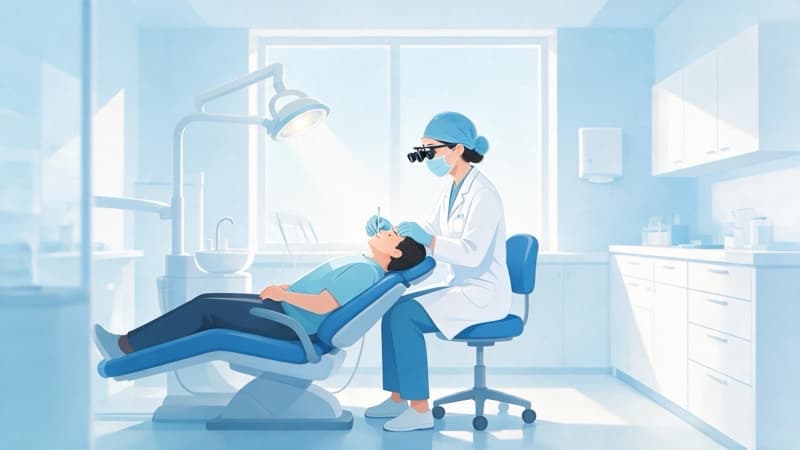
The Problem
The lower back is the second most affected site of occupational strain among dentists. A 2021 survey by Zhang et al. (n=614) found a 12-month lower-back MSD prevalence of 50.8%, second only to the neck at 75.2%; shoulders and upper back reached 49.7% and 46.4% respectively.
As with the neck, lumbar damage is cumulative. Years of bending and side-twisting keep the lumbar discs under sustained high pressure — from lumbar muscle strain to disc herniation, which in severe cases can threaten the ability to keep practicing clinically.
Why It Happens
The direct cause is "bending to compensate": when the eyes cannot see clearly, the body automatically leans in. The indirect causes are written into the survey data — lower-back MSDs are strongly correlated with how the clinic organizes its work:
- Frequent overtime or delayed shifts: 2.07× the lower-back risk of rare overtime
- Not practicing four-handed dentistry (no assistant support): 1.80× the lower-back risk of dentists with an assistant
- Clinic staff shortage: risk rises to 1.82×
- Each additional working day per week: risk at any site rises to 1.45×
In other words, lumbar protection is not only a matter of the individual dentist's posture — it is also a matter of the clinic's staffing and workflow.
How to Fix It
Start by correcting your sitting posture. The ergonomically recognized essentials:
- Keep your back straight with the lower back firmly against the chair back, using lumbar support
- Place both feet flat on the floor, with knees at a 90°-100° angle
- Keep upper arms hanging naturally and close to the torso, with abduction under 20°
- Keep the head in a neutral position, with the line of sight perpendicular to the treatment area
- Relax and lower the shoulders; avoid shrugging
- Position hand work at elbow level or slightly below
Then get the "hardware" right — the key adjustments for both chairs:
- Patient chair: For maxillary treatment, place the patient in a supine position (chair back nearly horizontal); for mandibular treatment, a semi-supine position (chair back raised about 30°-45°) is appropriate
- Patient chair: Adjust the patient's head height to the practitioner's elbow level
- Patient chair: Ensure the patient's head and the practitioner's operating area are in the same vertical plane
- Practitioner stool: Adjust seat height so the thighs are parallel to the floor
- Practitioner stool: Use a stool with lumbar support, or add a lumbar cushion
- Practitioner stool: The stool should have good armrests to support the weight of the arms
Finally, fix the rhythm: 1-2 work-breaks per day (lower back OR 0.55), 30-60 second micro-breaks between patients; where possible, practice four-handed dentistry so the assistant handles instrument transfer and suction while you twist and reach less.
References
[1]Correlation Analysis Between Musculoskeletal Disorders and Workload Among Dental Practitioners
Zhang P, Zhang W, Jiang C, Li X, Chen H, Zhang Y, Huang H · Occupational Health and Emergency Rescue, 39(1): 6-11 · 2021 · DOI: 10.16369/j.oher.issn.1007-1326.2021.01.002
A survey investigating the prevalence of musculoskeletal disorders among dental practitioners and their relationship with workload. 614 dentists participated; the overall MSD prevalence was 82.4%.
[2]Practice Dentistry Pain-Free: Evidence-based Strategies to Prevent Pain and Extend Your Career
Valachi B, Valachi K · Posturedontics Press (monograph) · 2008
A classic monograph on clinical dental ergonomics, systematically covering practitioner and patient positioning, stool and dental chair adjustment, instrument selection, and workplace exercise. The primary methodological reference for this site's correct-posture, equipment-adjustment, and workstation-layout content.
[3]A systematic review of musculoskeletal disorders among dental professionals
Hayes M, Cockrell D, Smith DR · International Journal of Dental Hygiene, 7(3): 159-165 · 2009 · DOI: 10.1111/j.1601-5037.2009.00395.x
A systematic review of the prevalence and risk factors of musculoskeletal disorders among dental professionals: prevalence is consistently high (mainly neck, lower back, and shoulders), associated with prolonged static load, poor posture, and repetitive tasks. One of the primary literature sources for this site's posture-hazard and prevention framework.